Advisor: Markus Eberl
How can millions of particle images become evidence that archaeologists can compare across mortar samples? We developed a computer-vision workflow that converts repeated particle views into quantitative composition profiles. Those profiles support comparisons across sites and can inform, rather than by themselves prove, hypotheses about resource use, trade, and cultural exchange.
From particles to composition
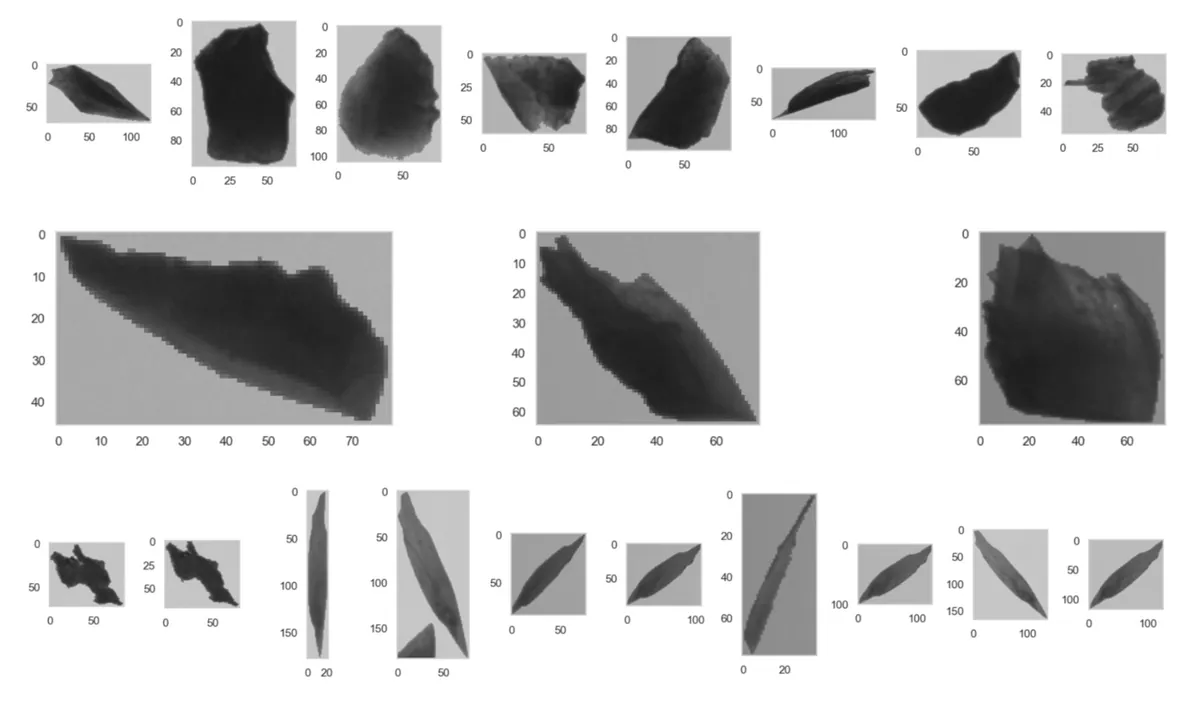
Each sample passes through a gravity-fed apparatus that isolates individual particles. A high-speed imaging system captures several views of every particle, producing approximately 10 million images. A Vision Transformer then assigns each view to one of four study-defined categories: Kurkar, Oliverpress, Volcanicash, or Sand, and records a confidence score.
The post-processing pipeline turns those image-level predictions into sample-level measurements:
- It removes view-level predictions below a configurable confidence threshold, such as 0.9.
- It aggregates the retained views to assign one label to each particle.
- It calculates class proportions from the retained particle assignments.
Representing a sample as a distribution over particle classes makes the comparison quantitative and reproducible. In the reported evaluation, the Vision Transformer increased classification accuracy from 60% to 97%. Confidence filtering improves the reliability of retained assignments, but it also changes coverage; accuracy and retained-sample coverage therefore need to be interpreted together.
Provenance at practical speed
We also developed a vision-only provenance method for comparing sample-level composition profiles. In the reported workflow, it reduced similarity-analysis runtime from months to minutes, making broader comparisons practical. The resulting similarity is computational evidence for investigation, not a provenance determination on its own; archaeological context remains necessary for interpretation. At the time of the original project write-up, a manuscript describing the method was in preparation.