This is an idea I am still exploring, not a launched service.
The problem
Most of what a personal website needs is already in a resume. The hard part is turning those facts into a clear story, which still demands document parsing, editing, design, front-end development, and deployment. Existing site builders reduce the coding burden but often leave the user to reconstruct the content by hand.
What it could do
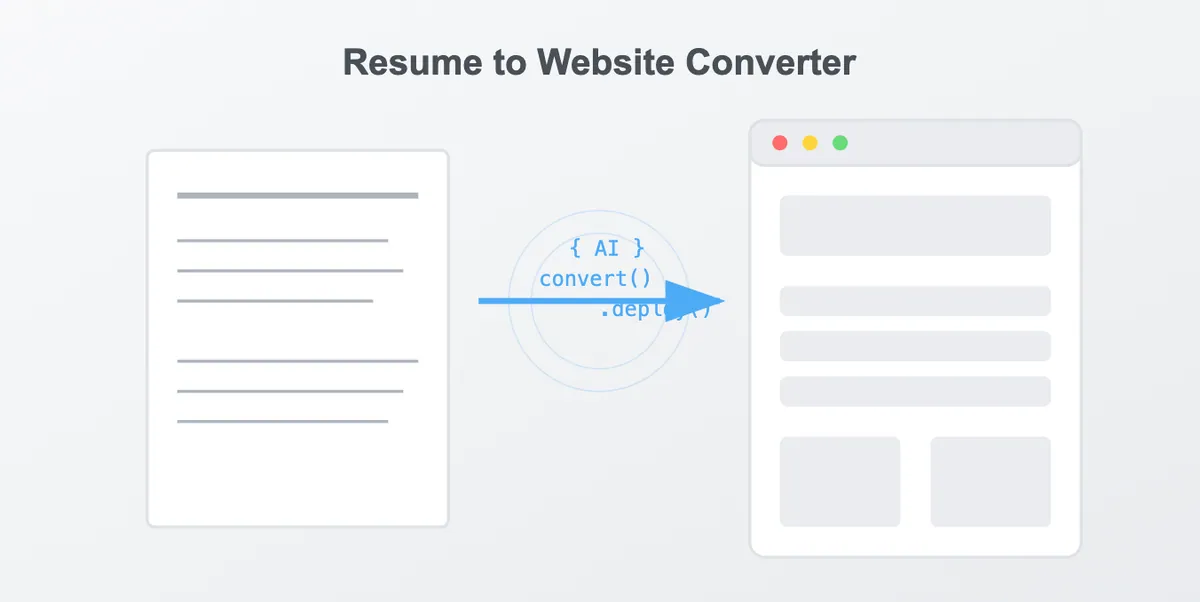
Resume2Web would accept a PDF or Word resume, recover its structured information, help the user refine the writing, and generate an editable, responsive website. The user would review every proposed change before publishing. GitHub Pages would provide a low-cost default deployment path, with optional custom-domain support.
The product would focus on three outcomes:
- preserve factual accuracy while improving structure and readability;
- offer coherent visual identity choices without requiring design expertise;
- make the generated site portable, editable, and owned by the user.
How it could work
- Parse the document. OCR and text extraction identify education, experience, projects, skills, and contact details, then normalize them into a versioned JSON schema.
- Review the evidence. The interface shows each extracted field beside its source so the user can correct parsing errors before generation.
- Shape the narrative. An LLM proposes a biography, concise achievement statements, skill summaries, and SEO metadata. Claims remain linked to the approved source data.
- Choose a presentation. Modular templates provide responsive layouts, typography, color, portfolio sections, and optional visual-identity elements. The output remains standard web code and Markdown rather than a locked format.
- Publish safely. A GitHub integration creates or updates a repository, configures GitHub Pages, verifies the build, and supports a custom domain when requested.
Questions to answer
- How accurately can one parser handle conventional, highly designed, multilingual, and non-standard resumes?
- What review workflow prevents an LLM from changing terminology, inventing achievements, or weakening precise claims?
- Can the template system stay flexible without making generated sites difficult to maintain?
- How should API credentials, GitHub authorization, private resume data, retries, and failed deployments be handled securely?
- What caching and asset pipeline keep generation fast while producing accessible, SEO-friendly, cross-browser output?
What I would test first
The first prototype should measure extraction accuracy, correction time, successful site-generation rate, deployment success rate, page performance, and the time required to reach a publishable result. User research should test whether people trust the proposed edits, understand what will be made public, and prefer the result to a conventional site builder. Only then would pricing, premium customization, or an institutional offering be meaningful questions.
Where it could go
I would start with parsing, human review, a small template set, and GitHub Pages deployment. Later experiments could add analytics, a user dashboard, more templates, custom domains, portfolio and blog modules, LinkedIn synchronization, and carefully reviewed content updates. A marketplace or professional-services layer would remain a later possibility, contingent on evidence that users need it.