This is an idea I am still exploring, not a launched service.
The problem
Reading and highlighting can create a sense of familiarity without revealing whether a concept is truly understood. The Feynman Technique addresses this by asking a learner to explain an idea simply, locate the gaps, and try again. Applying that loop across a large subject, however, makes it difficult to track dependencies, choose the next concept, and revisit weak areas at the right time.
What it could do
Feynman Monitor would turn a learner's spoken or written explanations into an evolving map of concepts, relationships, prerequisites, and open questions. Instead of presenting a generic chatbot, it would guide a repeatable learning loop: explain, question, inspect the gap, revise, and connect the result to what comes next.
How it could work
- Capture an explanation. The learner speaks or types in the language they prefer. Speech-to-text and multi-format import make notes, readings, and other study material available as context.
- Probe the reasoning. An LLM asks targeted follow-up questions, checks the answer against available evidence, and identifies concepts that are missing, uncertain, or conflated.
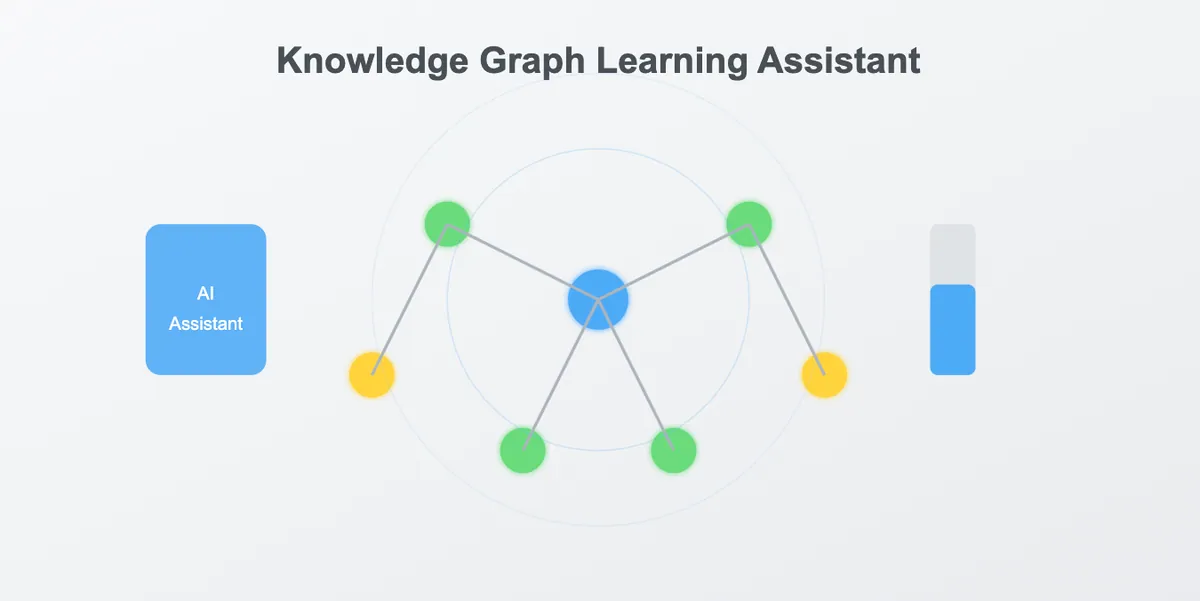
- Build the knowledge graph. The system creates and updates concept nodes, prerequisite edges, topic clusters, and supporting resources while preserving the context behind each relationship.
- Recommend the next step. Gap analysis and prerequisite mapping produce a personalized learning path rather than a fixed sequence.
- Make progress visible. An interactive graph shows what the learner has explained, where confidence is weak, and how the current topic connects to the larger subject.
Questions to answer
- How should the system distinguish a clear explanation from a fluent but incorrect one?
- What evidence and uncertainty signals should accompany answer validation and generated questions?
- How can the knowledge graph evolve without duplicating concepts or creating misleading relationships?
- Which recommendation method balances prerequisites, learner goals, forgetting, and available study time?
- Can real-time transcription, graph updates, and LLM responses remain fast and affordable at sustained usage?
- How should private voice recordings, notes, learning history, and institutional content be protected?
What I would test first
The first study should test whether guided explanation improves recall and transfer compared with ordinary review. Product measures would include question-answer accuracy, graph corrections, response time, completion of recommended learning loops, return rate, and whether learners can explain previously weak concepts more clearly. Interviews should examine trust, cognitive load, the usefulness of the visualization, and whether learners understand why a path was recommended.
Commercial validation would come later. It should test whether individual learners value a subscription and whether educational institutions need licensing, administration, or learning-management-system integration.
Where it could go
I would start with text input, guided questioning, basic concept nodes, and a simple learning-path view. A second stage could add voice processing, richer graph visualization, gap analysis, and resource recommendations. Collaborative learning spaces, study groups, tutoring integrations, gamification, community knowledge sharing, and institutional integrations would remain later experiments, introduced only when the core learning loop proves useful.