

Advisor: Ray Friedman
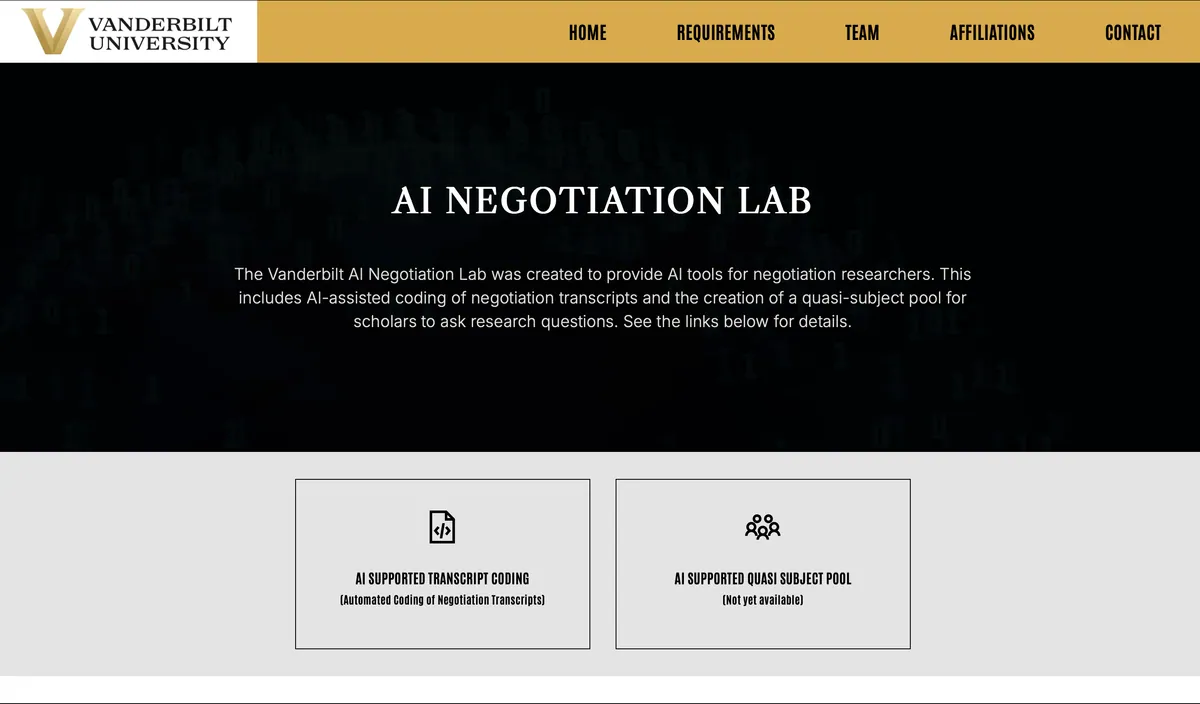
I explored two connected questions in negotiation research: how AI can help code existing transcripts, and how it can generate controlled scenarios for future studies.
Coding negotiation transcripts
I built the first system to help researchers turn unstructured negotiation transcripts into structured observations.
- What it codes: It assigns predefined labels, such as "Substantiation" or "Providing Information," to transcript segments according to a researcher's coding scheme.
- How I checked consistency: It runs five coding passes, measures agreement across the outputs, and reports a consistency value so researchers can inspect uncertain cases.
- Cost and agreement: The pipeline reduced the cost of coding one transcript from more than $5,000 to $3 and increased human–AI agreement from 30% to 80%.
Developing the system required careful preprocessing of a private, high-quality transcript dataset. I evaluated GPT-4, Claude 2, Claude 3 Sonnet, Claude 3 Opus, Claude 3.5 Sonnet, and Claude 3.5 Sonnet-latest, then experimented with prompt design, in-context learning examples, and evaluation metrics.
I presented this work at the 2025 AI Negotiation Summit at Harvard and MIT.
Simulating negotiation scenarios
The second research track explores LLM agents that negotiate under assigned experimental conditions. The goal is to generate realistic, diverse transcripts while giving researchers control over the population-level variation represented by the agents. This could lower the cost of collecting negotiation data and make it easier to test a wider range of scenarios.
I worked on this with Professor Ray Friedman and the AI Negotiation Lab research team.